Why OB Wireless Planning Is Different from Studio Work
A controlled studio environment gives you predictable RF conditions, fixed camera positions, managed power, and a contained space. An outside broadcast gives you none of these guarantees.
The RF environment at most OB venues is already occupied before your crew arrives. Mobile networks, venue Wi-Fi infrastructure, other broadcasters' systems, IEM rigs for performers, and whatever the local environment contributes all add to the noise floor that your wireless systems need to operate above. At a major sports venue or live event, the congestion is substantial.
Camera positions on an OB are often elevated, temporary, and at distances where a cable run would require excessive lengths, create management problems, or simply isn't physically achievable. A camera on a roof position 400 m from the truck, a jib arm over a pitch, or a handheld camera in a crowd area. All of these require wireless links specified correctly for the environment.
Start with the RF Survey
Before specifying any wireless system for an OB, a site survey is the necessary first step. Visiting the venue and walking the camera positions tells you things that a venue plan cannot: actual line-of-sight between transmitter and receiver positions, physical obstructions, the presence of RF-reflective surfaces, and the baseline RF noise at the venue on a representative day.
An RF spectrum scan at the venue during a similar event, such as another match day or a previous broadcast at the same location, gives you a real picture of frequency occupation that you can plan around. A scan during a quiet period will underrepresent the congestion you will face on the day.
From the site survey, map every camera position, confirm line-of-sight to the proposed receiver locations (typically at or near the OB truck or technical area), and note any positions where obstructions make direct line-of-sight difficult.
Matching the Wireless System to the Camera Position's Requirements
Each camera position on an OB has a specific data requirement. The wireless system for that position should carry exactly what the position needs and nothing more.
- A remote camera position that feeds a Sony broadcast camera to the gallery with no additional data requirement needs a wireless system that carries HD video and Sony 700 camera control. If it also needs a network connection for metadata or file transfer, the system needs to carry IP data as well.
- A camera position that carries HD video only (without shading control) needs a video-only or video-plus-IP wireless link, not a combined system carrying control data it will not use.
Working through each camera position and specifying the wireless system against its actual requirement keeps the hire cost accurate and the RF environment less congested.
Frequency Coordination on an OB
Frequency coordination on a medium or large OB is not optional. It is the difference between a broadcast that runs cleanly and one that has dropouts at critical moments.
Coordinate your wireless frequencies with the venue's own RF coordinator, with other broadcasters sharing the location, and with any IEM or radio mic systems operating at the same time. Obtain a full frequency list from all parties and plan your wireless system operating frequencies to avoid clashes.
The specific frequency bands available for broadcast wireless use in the UK are subject to Ofcom licensing and band plan. Some frequency ranges require a specific licence for use, and this needs to be confirmed before the shoot rather than assumed. Building in frequency agility (the ability to retune your wireless systems quickly if a conflict appears on the day) is valuable insurance.
Antenna Placement and Cable Runs
The best wireless system in the world performs poorly if the receive antenna is poorly placed. On an OB, antenna placement at the receiver end is often as important as the system specification itself.
For camera positions at the far end of a pitch or at significant elevation, a passive antenna placed higher and with a clear line-of-sight to the camera position outperforms an antenna closer to the truck but with an obstructed path. The cable run from the remote antenna back to the receiver in the truck introduces signal loss, but that loss is predictable and manageable with appropriate cable quality and length.
Managing Multiple Wireless Systems on the Day
On a multi-camera OB, the RF environment changes throughout the production day. Crowd density builds before and during an event, additional wireless systems may appear that were not in the pre-event frequency coordination, and conditions at elevated or exposed antenna positions change with weather.
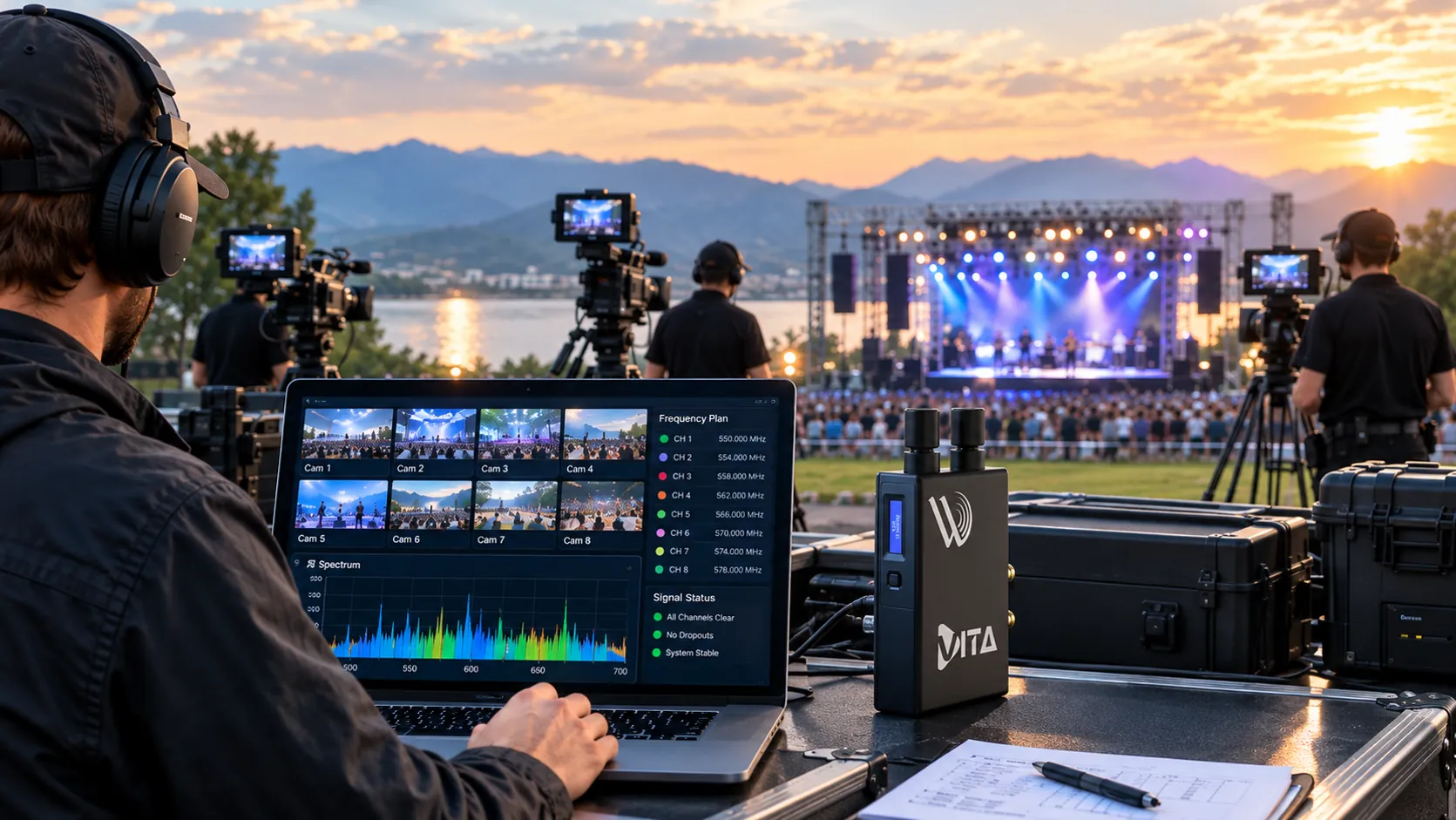
Having an RF coordinator monitoring spectrum activity during the broadcast allows rapid response to interference events before they become visible on output. Monitoring the receive signal levels of each wireless link and having a process for retuning is standard practice on professional OB wireless setups.
Related Equipment
Further Reading
- Ofcom PMSE licensing Licensing for Programme Making and Special Events spectrum in the UK.
- IAMT Tech Office (formerly IABM) Technical resources from the association for broadcast and media technology.