What Is a V-Mount Battery?
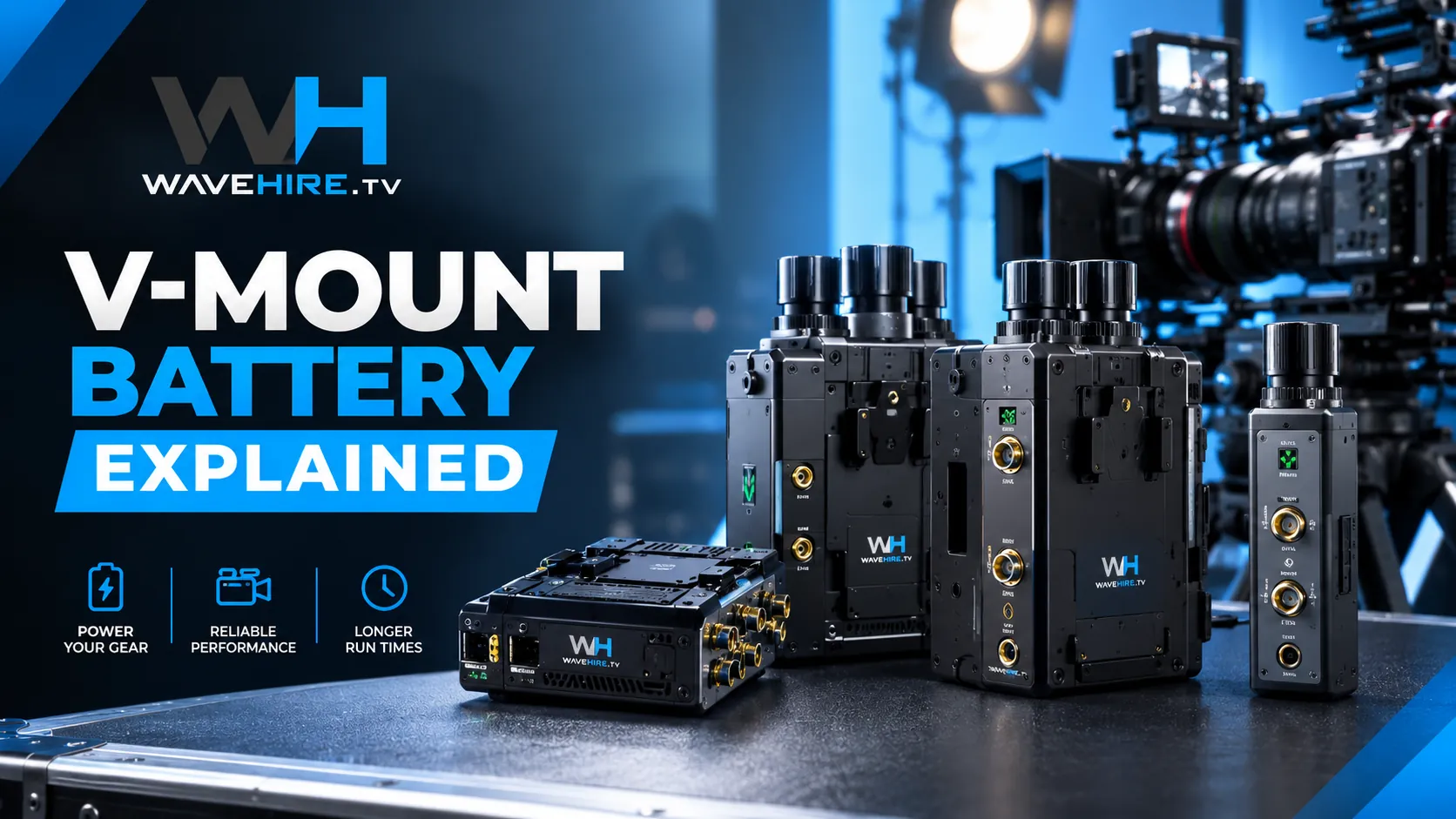
A V-Mount battery is a rechargeable lithium-ion battery pack that connects to broadcast equipment via a standardised V-shaped locking mount (hence the name). The V-Mount standard, originally developed by Sony, is used across a wide range of professional broadcast equipment from multiple manufacturers: cameras, wireless transmitters, monitor rigs, on-camera lights, and field recorders all use V-Mount as their primary removable power source.
The V-Mount connector provides a secure mechanical connection and a standardised power output interface. The battery slides onto the V-shaped rail and locks in place, preventing accidental disconnection during movement, which is important on handheld cameras, Steadicam rigs, and wireless transmitters mounted on active camera positions.
V-Mount vs Anton Bauer: What's the Difference?
Anton Bauer and V-Mount are both removable broadcast battery systems, but they use different physical mounts and are not cross-compatible without an adapter. Anton Bauer batteries use a three-point mount system (the "Gold Mount" format), while V-Mount uses the V-shaped rail system.
| Comparison | V-Mount | Anton Bauer |
|---|---|---|
| Physical mount | V-shaped rail system | Three-point mount (the Gold Mount format) |
| Cross-compatibility | Needs an adapter | Needs an adapter |
| In UK broadcast production | More commonly encountered on camera positions | Common in certain market segments |
| FLEX series wireless systems | Accepted | Accepted |
Both standards are mature and widely supported by broadcast equipment manufacturers. In UK broadcast production, V-Mount is the more commonly encountered standard on camera positions, though Anton Bauer remains common in certain market segments. The FLEX series wireless systems from WaveHire accept both V-Mount and Anton Bauer batteries, which is useful when working with crews who standardise on different battery formats.
Understanding Battery Capacity and Runtime
V-Mount batteries are rated in watt-hours (Wh), which represents the total energy capacity of the battery. A 98 Wh battery at 14.4 V nominal provides approximately 6.8 Ah of charge at that voltage.
For a wireless transmitter drawing a known wattage, runtime estimation is straightforward: divide the battery capacity in watt-hours by the transmitter's power draw in watts. A 50 Wh battery powering a transmitter drawing 10 W will run for approximately five hours under ideal conditions. In practice, slightly less due to battery efficiency and the reduction in usable capacity as the battery depletes.
For a full broadcast day (ten to twelve hours on location), a single V-Mount battery of typical capacity (98 Wh to 150 Wh) is not sufficient for an uninterrupted run. Planning battery rotation, with charged spares available on set and a charging point accessible at the truck or a nearby power source, is standard production practice.
Voltage Outputs on V-Mount Batteries
Modern V-Mount batteries typically provide two voltage outputs alongside the main mount output: a 14.4 V (or 12 V on some models) D-tap (also called P-tap) output for powering accessories via a barrel connector, and in many cases a USB output for lower-powered devices.
The D-tap output is commonly used to power ancillary devices from the camera or transmitter battery: wireless follow focus receivers, on-camera monitors, and small accessories that can run on 12 V or 14.4 V. The availability and amperage of the D-tap varies between battery models, so confirm the output specification if powering accessories through the D-tap.
What to Know About Battery Power When Hiring Wireless Systems
When hiring wireless transmitters (including the FLEX series from WaveHire), the battery configuration needs to be confirmed as part of the hire specification. The hire of the wireless transmitter does not automatically include batteries unless specifically agreed.
If you already have a V-Mount battery system on your camera package, confirm that the batteries in use are compatible with the wireless transmitter's power input. The transmitter will have a minimum and maximum input voltage specification. If your batteries' nominal or end-of-discharge voltage falls outside this range, you risk either underpowering the transmitter or damaging the unit.
V-Mount batteries vary in the precision of their voltage regulation. Professional-grade batteries from reputable manufacturers maintain consistent voltage output through most of their discharge cycle. Consumer-grade or lower-quality batteries may drop voltage more steeply near end of discharge, which can cause transmitters to power off unexpectedly before the battery indicator suggests depletion.
Practical Battery Management on a Wireless Shoot
Battery management on a wireless broadcast shoot is a crew responsibility that benefits from a clear system. Label batteries with tape or markers showing capacity and charge state. Rotate batteries systematically: dead batteries go immediately to the charging point, and fully charged batteries return to a designated position on the cart.
For continuous operation where a power interruption would be critical (a live broadcast camera position, for example), a distribution system that allows hot-swapping from external power is worth building into the rig design. Some wireless transmitters support this by accepting power via both the V-Mount plate and an auxiliary power input simultaneously, allowing a swap without powering off the transmitter.
Related Equipment
Further Reading
- Wikipedia: V-mount Background on the V-Mount battery standard and its history.
- Wikipedia: Lithium-ion battery How lithium-ion cells work, charge and age.