
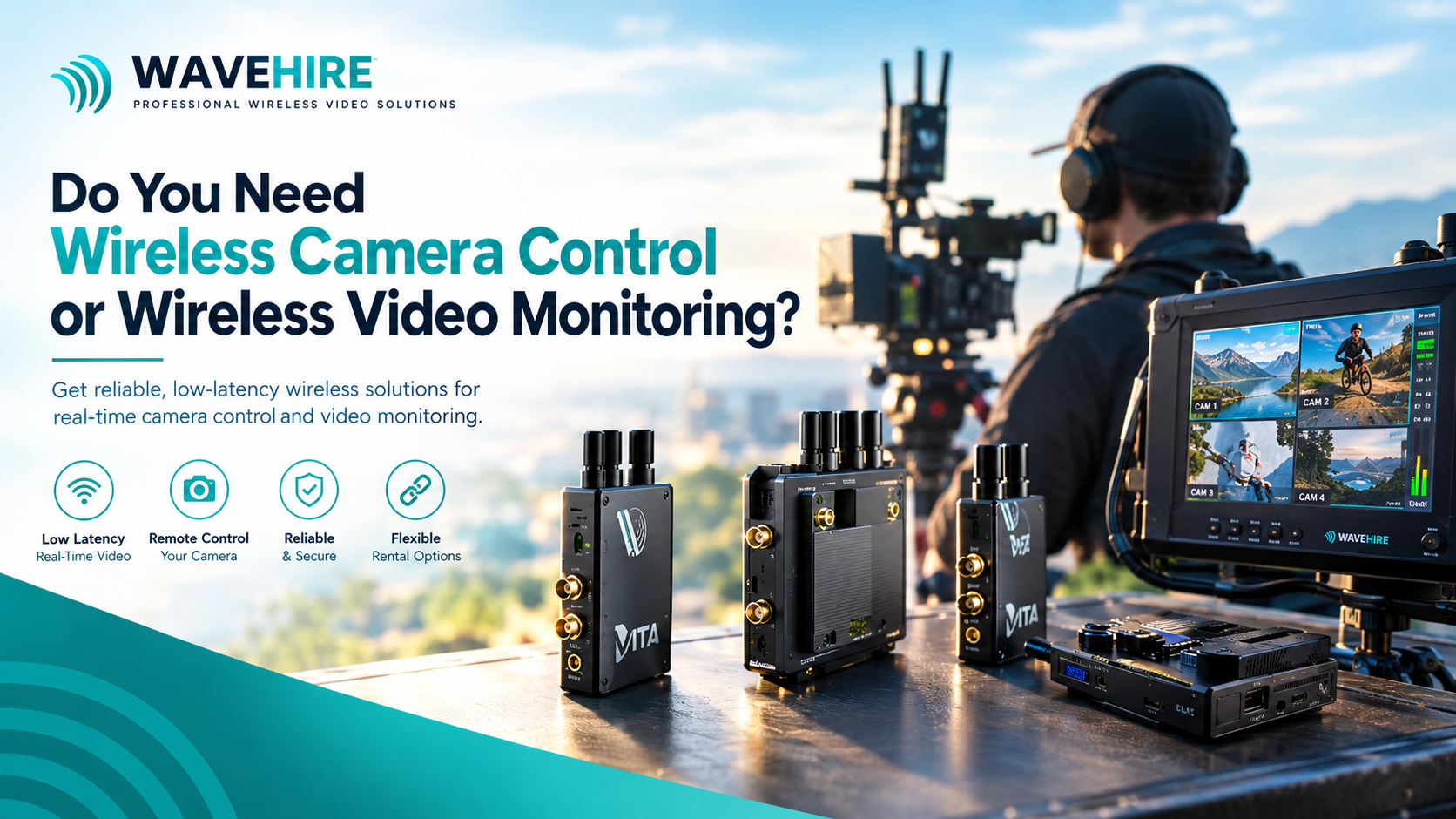
Wireless camera control and wireless video monitoring solve different production problems, and confusing the two is one of the most common mistakes when hiring wireless broadcast equipment. This guide explains what each system does, how they differ, and how to determine which one your production needs — or whether you need both. WaveHire provides both system types for hire across the UK. Browse all wireless systems.
What Does Wireless Camera Control Actually Do?
Wireless camera control sends command data — iris, gain, white balance, colour matrix, tally, and other parameters — from a remote control panel (RCP) to the camera. It gives the shader or vision engineer wireless access to every camera function they would normally control through a triax or fibre cable. It does not carry any video signal.
The CC-LINK systems provide three camera control options, all operating at up to 1 km line-of-sight:
- CC-LINK IP: Wireless IP data bridge. Carries IP-based control data at up to 150 Mbps. £100/day.
- CC-S700: Sony 700 protocol control. AES-encrypted control and status data via 6-pin LEMO. £125/day.
- CC-LINK COMBO: Sony control + IP data on one link. £135/day.
What Does Wireless Video Monitoring Actually Do?
Wireless video monitoring sends the camera's video output (HD-SDI or HDMI) to a receiver connected to a monitor. The director, DOP, script supervisor, or any other crew member can view the live camera feed on a screen that is not physically connected to the camera. Monitoring systems carry no camera control data and no IP data — they show the picture only.
The VITA monitoring systems provide two options:
- VITA PRO System: TX + RX kit. Up to 600 m line-of-sight, enhanced multi-antenna, 2x HD-SDI + HDMI. £125/day.
- Vita Lite System: TX + RX kit. Up to 300 m line-of-sight, compact (260g TX, 240g RX), 1x HD-SDI + HDMI. £90/day.
How Do You Know Which One Your Production Needs?
The answer depends on what problem you are solving.
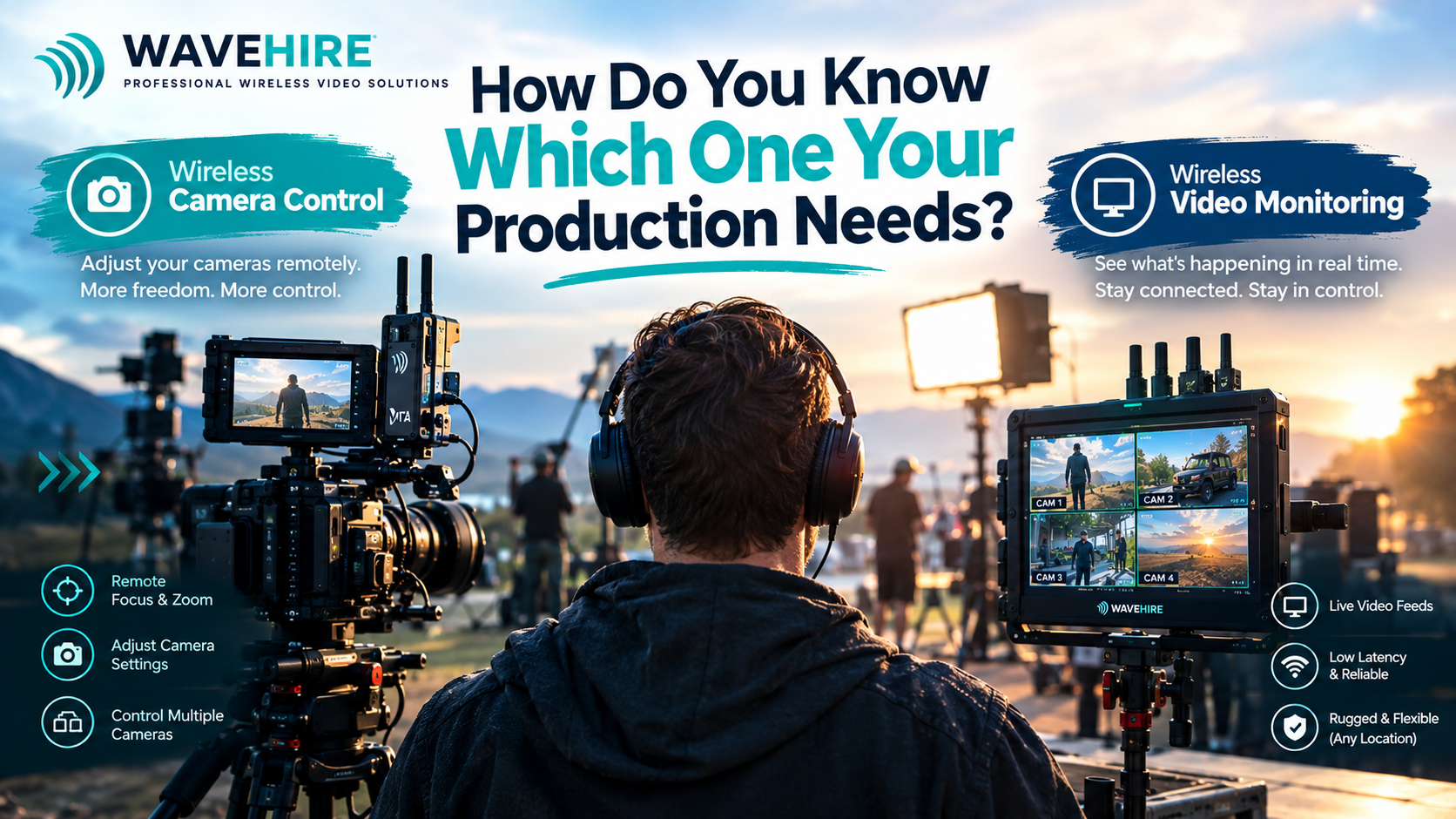
You Need Camera Control If
- The shader needs wireless access: Your cameras are cabled for video (triax, fibre, SMPTE hybrid), but the shader's RCP cannot reach certain camera positions by cable.
- You are adding cameras to an existing OB setup: The OB truck handles video via cable, but additional camera positions are out of control cable range.
- You need IP connectivity: You need a wireless LAN bridge between two production points for IP-based camera control or data transfer.
You Need Video Monitoring If
- The director or DOP needs a wireless picture: You want crew members to see the camera feed on monitors that are not connected to the camera by cable.
- You are moving monitors frequently: The monitoring position changes during the production day, making cabling impractical.
- You need multiple monitoring points: Several crew members in different locations need to see the same camera feed simultaneously.
You Need Both If
Your production requires wireless camera shading and wireless monitoring for different purposes — the shader needs wireless control from the gallery, and the director needs a wireless monitor on the studio floor. In this scenario, you would hire CC-LINK for camera control and VITA for monitoring.
What If You Need Wireless Video and Camera Control on the Same Link?
The FLEX systems solve this by combining HD video transmission with camera control and/or IP data on a single wireless system. Instead of hiring separate camera control and video systems, one FLEX unit replaces both.
- FLEX S700: HD video + Sony camera control on one link. £200/day.
- FLEX Fusion: HD video + IP data + Sony camera control on one link. £225/day.
How Do You Decide What to Hire for Your Production?
Start by listing every wireless function your production needs: camera control, video transmission, monitoring, or a combination. Then match each function to the correct system category. If you are unsure, the WaveHire team can advise based on your production format, venue, camera count, and existing infrastructure.
Every system is fully tested and paired before dispatch. Equipment can be shipped 1–2 days before your production anywhere in the UK, or collected same-day from our London facility. Contact the team to confirm exactly what is included with your hire.