
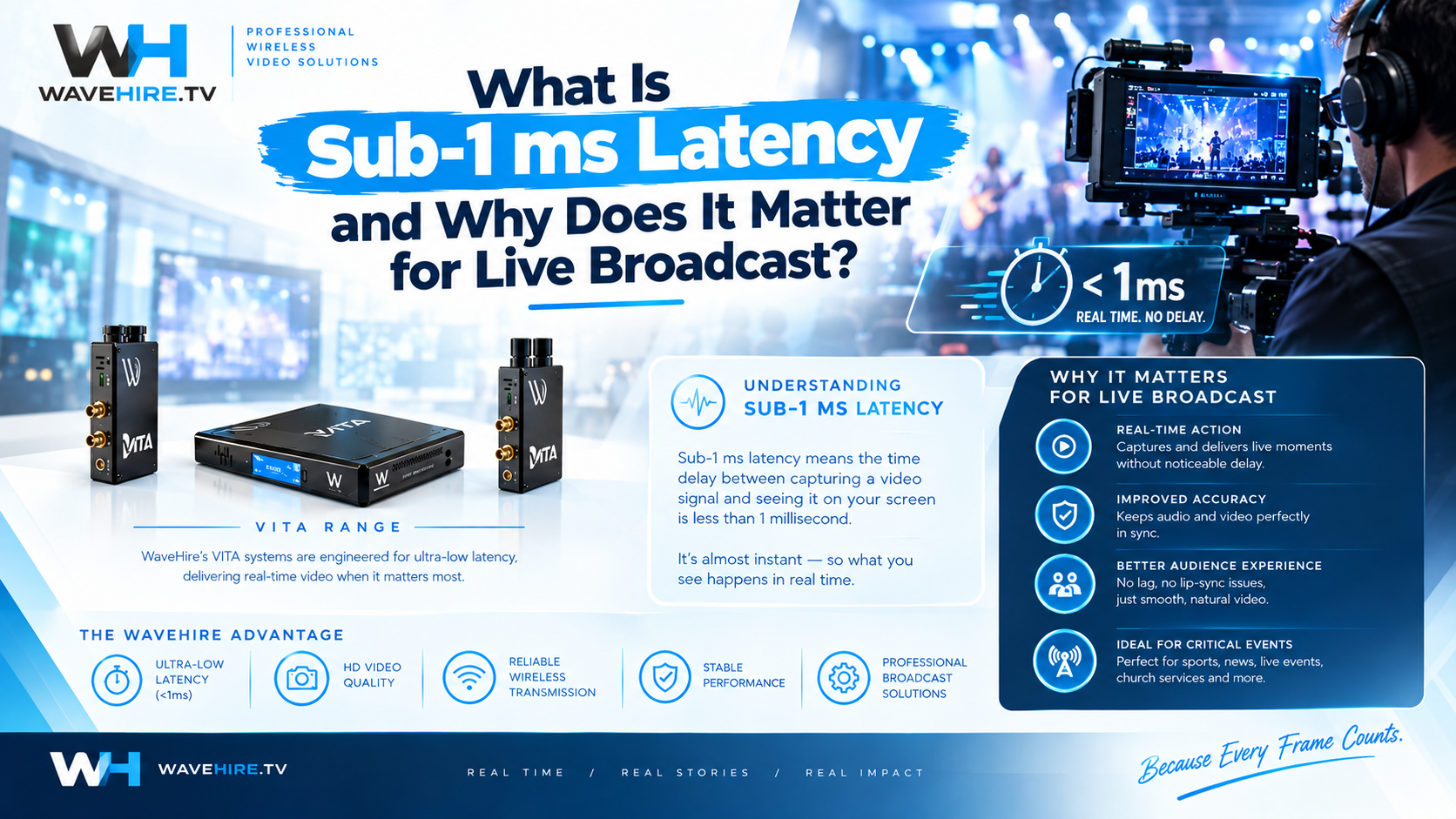
Sub-1 ms latency in wireless broadcast means the system adds less than one millisecond of delay to the video signal as it travels from the camera's output to the receiver's output. This guide explains why latency is the defining performance metric for live broadcast wireless systems, how the FLEX and VITA series achieve sub-1 ms system latency, and why consumer-grade alternatives fall short of broadcast requirements. Browse every sub-1 ms latency system in the range.
How Is Latency Measured in Wireless Video Systems?
Latency — also called delay or lag — is measured as the time difference between a video frame leaving the camera's SDI output and that same frame appearing at the receiver's SDI output. It is measured in milliseconds (ms). A system with sub-1 ms latency adds less than one thousandth of a second to this journey. At standard broadcast frame rates (25 fps for UK production), one frame lasts 40 ms. Sub-1 ms latency means the wireless link adds less than 1/40th of a frame of delay, in line with SMPTE's broadcast timing and synchronisation standards.
Why Does Latency Matter for Live Switched Production?
In a live multi-camera production, the vision mixer cuts between camera feeds in real time. Every feed arriving at the mixer must be frame-synchronous — if one camera's feed is delayed by even two or three frames relative to the others, cuts to that camera produce a visible jump, and any transitions (dissolves, wipes) show misalignment between the outgoing and incoming pictures.
Consumer wireless video systems commonly introduce 20–80 ms of latency — one to three frames at 25 fps. This is invisible when monitoring a single camera feed on a director's monitor, but it is immediately obvious when switching between a cabled camera (zero wireless delay) and a wireless camera (60 ms behind). The cabled feed is live; the wireless feed is showing what happened three frames ago.
Where Latency Becomes Critical
- Live sport: The director cuts to a close-up camera for a replay or reaction. If that camera's wireless feed has 60 ms of latency, the cut arrives two frames late relative to the action.
- Music and performance: Audio synchronisation is critical. Even small video delays create a visible lip-sync error when the programme audio is live.
- News and live events: Fast-paced live switching requires every feed to respond instantly to the director's cuts.
How Do Broadcast Systems Achieve Sub-1 ms Latency?
The FLEX and VITA series use a combination of OFDM encoding and direct signal processing to minimise the delay in the encoding-transmission-decoding chain.
OFDM Encoding
OFDM (Orthogonal Frequency-Division Multiplexing) splits the video data across multiple carrier frequencies transmitted simultaneously. This parallel transmission approach is inherently faster than serial encoding methods used by consumer systems, which compress the video, buffer it, transmit it, buffer again, and decompress — each step adding milliseconds.
Minimal Processing Pipeline
Broadcast-grade wireless systems use hardware-level signal processing rather than software-based compression. The video signal is encoded and transmitted with minimal buffering, reducing the processing chain to a fraction of the time required by H.264 or H.265 compression used in consumer devices. The FLEX series delivers sub-1 ms latency using exactly this approach.
How Does Sub-1 ms Latency Compare to Consumer Wireless Systems?
The difference between broadcast and consumer wireless video systems is not a subtle specification — it determines whether the system can be used for live switched production at all.
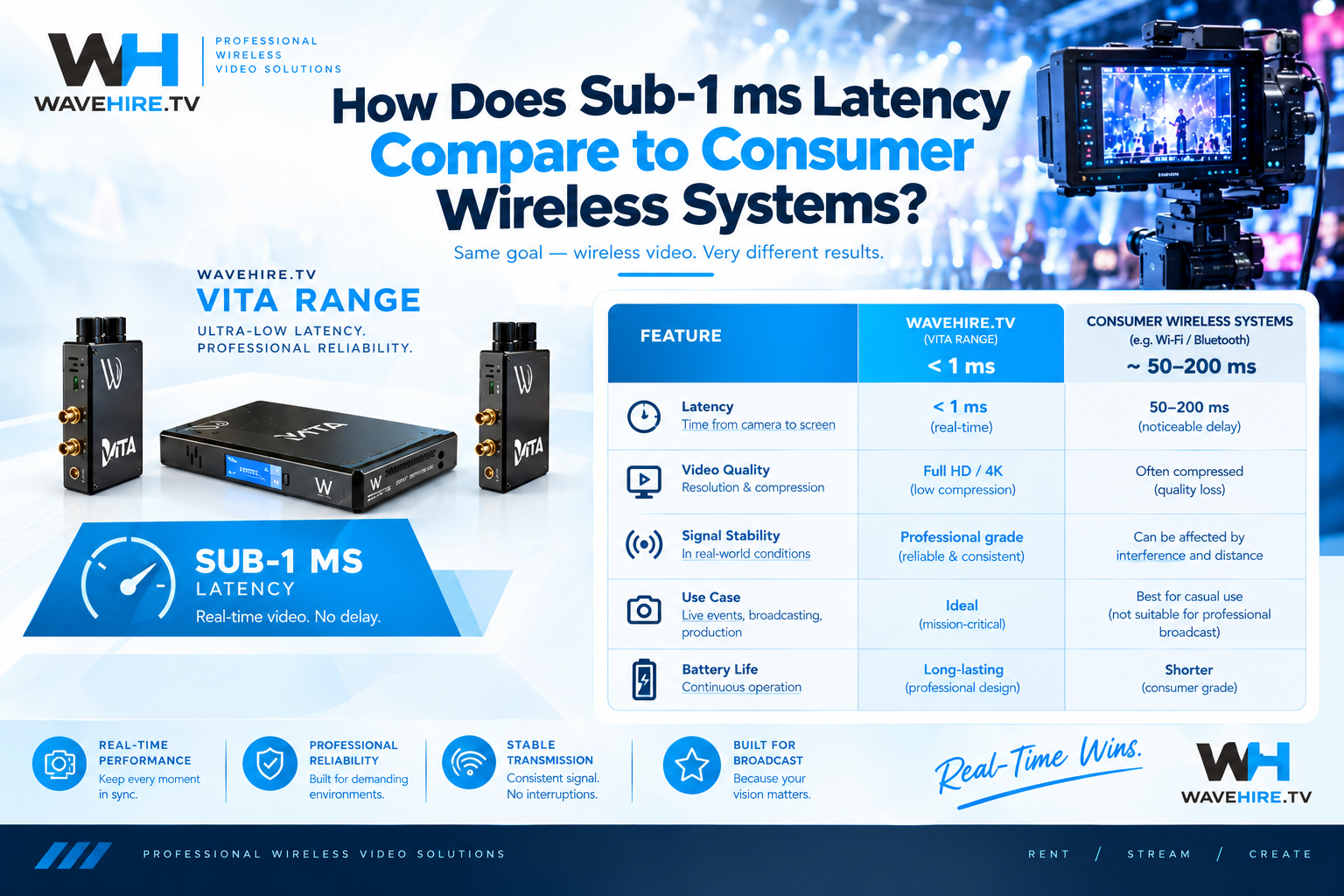
- Sub-1 ms (FLEX, VITA series): The wireless feed arrives at the vision mixer in the same frame window as cabled feeds. The director and vision mixer cannot distinguish between cabled and wireless cameras. Clean cuts, dissolves, and effects work without compensation.
- 20–40 ms (mid-range systems): Visible on fast cuts. Lip-sync errors possible. May be acceptable for monitoring but not for live switching.
- 50–80 ms (consumer systems): Clearly visible delay. Unsuitable for any live switched production. Acceptable only for confidence monitoring where timing is not critical.
Which WaveHire Systems Deliver Sub-1 ms Latency?
All FLEX and VITA series systems deliver sub-1 ms system latency for video transmission.
- FLEX IP: Sub-1 ms latency with HD video + IP data. From £175/day. View product page
- FLEX S700: Sub-1 ms latency with HD video + Sony camera control. From £200/day. View product page
- FLEX Fusion: Sub-1 ms latency with HD video + IP data + Sony camera control. From £225/day. View product page
- VITA PRO System: Sub-1 ms latency wireless monitoring. From £125/day. View product page
- Vita Lite System: Sub-1 ms latency compact monitoring. From £90/day. View product page
All systems are fully tested and paired before dispatch. Equipment is available for hire across the UK, with shipping 1–2 days before your production or same-day collection from our London facility. Get a quote from the team.