
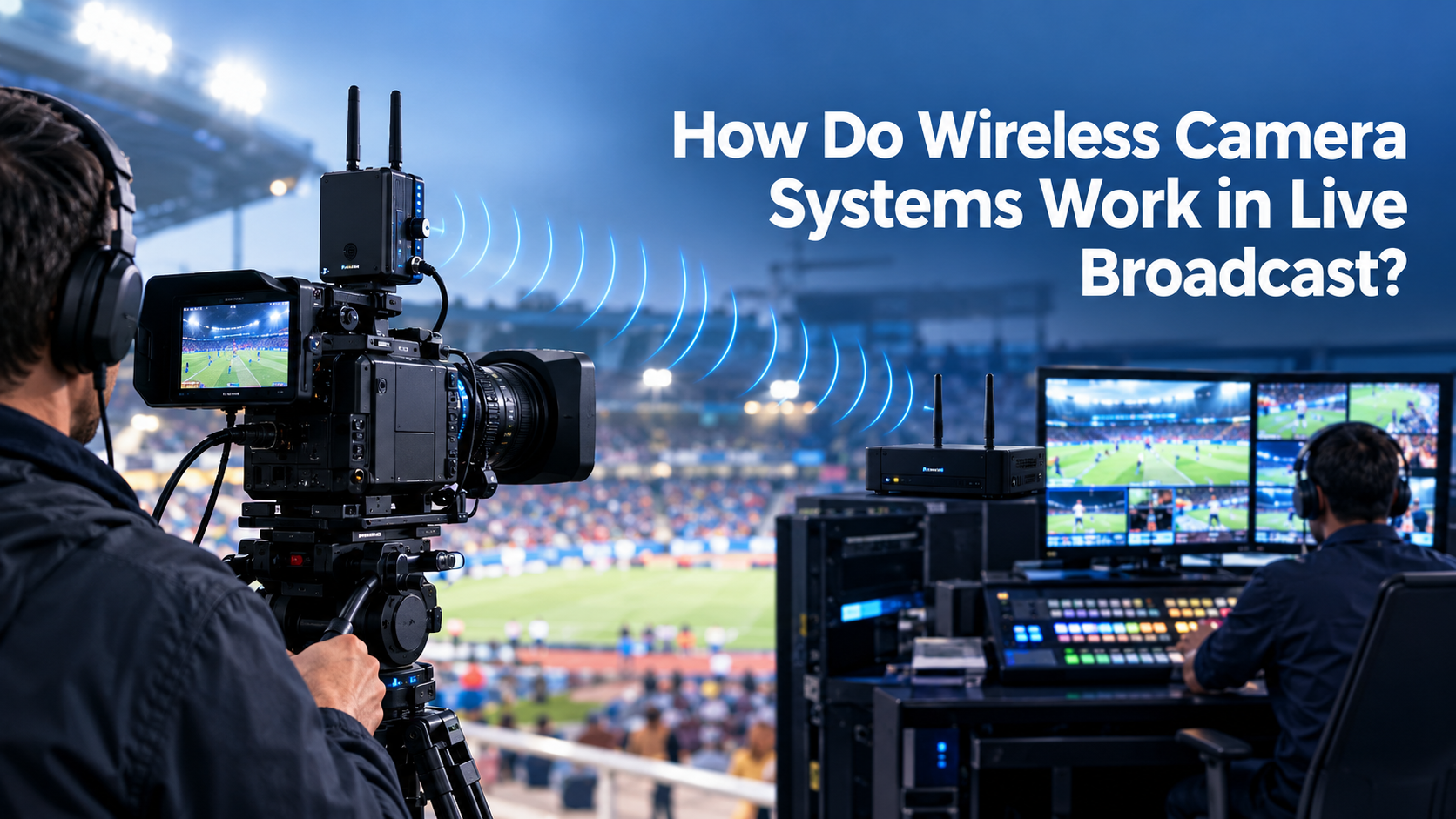
Wireless camera systems allow broadcast crews to transmit camera control data, live video, or both without physical cable runs between the camera position and the production gallery. This guide explains how each type of wireless broadcast system works, what it carries, and how productions across the UK use them for outside broadcast, live events, and multi-camera shoots. Browse the full equipment catalogue to see every system mentioned below.
What Are the Three Types of Wireless Broadcast System?
Every wireless broadcast link falls into one of three categories, and understanding the distinction is essential before choosing equipment for any production.
Wireless Camera Control
Camera control systems carry command and status data between a remote control panel (RCP) and the camera. This includes iris, gain, white balance, colour matrix, and tally. They do not carry any video signal. The data travels on dedicated frequencies, typically 2.4 GHz or 900 MHz, protected by AES encryption. Camera control links like the CC-LINK series reach up to 1 km line-of-sight, giving the shader full control of the camera from anywhere within range.
Wireless Video Transmission
Video transmission systems carry HD-SDI and HDMI signals from camera to production. They operate on 5 GHz bands using OFDM encoding to deliver broadcast-quality pictures with sub-1 ms system latency. The FLEX series combines video transmission with additional capabilities — IP data, Sony camera control, or both — on a single link, with range up to 600 m line-of-sight.
Wireless Monitoring
Monitoring systems carry video only, designed for directors, DOPs, and script supervisors to view a live feed without trailing cables. They carry no camera control and no IP data. The VITA series delivers sub-1 ms latency monitoring at distances up to 600 m (VITA PRO) or 300 m (Vita Lite) line-of-sight.
How Does Wireless Camera Control Work Without Carrying Video?
Camera control links operate on a separate principle from video transmission. The RCP sends parameter commands — numerical values for iris position, gain level, colour temperature — as small data packets. These packets require minimal bandwidth compared with a video stream. Because the data is lightweight, the system uses narrow-band frequencies (2.4 GHz or 900 MHz) that penetrate obstacles more effectively and maintain stable connections over longer distances than wideband video links.
The CC-S700, for example, uses the Sony 700 protocol via a 6-pin LEMO connector. It sends the same control data that would normally travel down a triax or fibre cable, but wirelessly. AES encryption protects this control and status data throughout transmission.
What Makes Wireless Video Transmission Broadcast-Grade?
Consumer-grade wireless video adapters introduce visible latency — sometimes 50 ms or more — making them unusable for live switched production. Broadcast-grade systems like the FLEX series use OFDM encoding on dual-band 5 GHz frequencies to achieve sub-1 ms system latency, as defined by the Society of Motion Picture and Television Engineers (SMPTE). That means the vision mixer sees the wireless camera feed at effectively the same moment as any cabled camera, allowing clean cuts and transitions without frame misalignment.
The FLEX series outputs on 2 x HD-SDI and HDMI simultaneously, supports V-Mount and Anton Bauer battery plates, and operates at distances up to 600 m line-of-sight. Actual performance depends on the environment, obstacles, and local RF conditions.
How Do Production Teams Use Wireless Systems on Location?
The way wireless systems are deployed depends on the production format and the crew requirements.
Outside Broadcast (OB)
OB productions at sporting events, concerts, and public ceremonies often position cameras hundreds of metres from the OB truck. Running cables across these distances creates trip hazards, requires council permissions, and limits camera repositioning. Wireless camera control systems let the shader control every camera parameter from the truck, while wireless video links deliver the picture back to the vision mixer, as outlined in the BBC Academy's outside broadcast production resources.
Live Events and Conferences
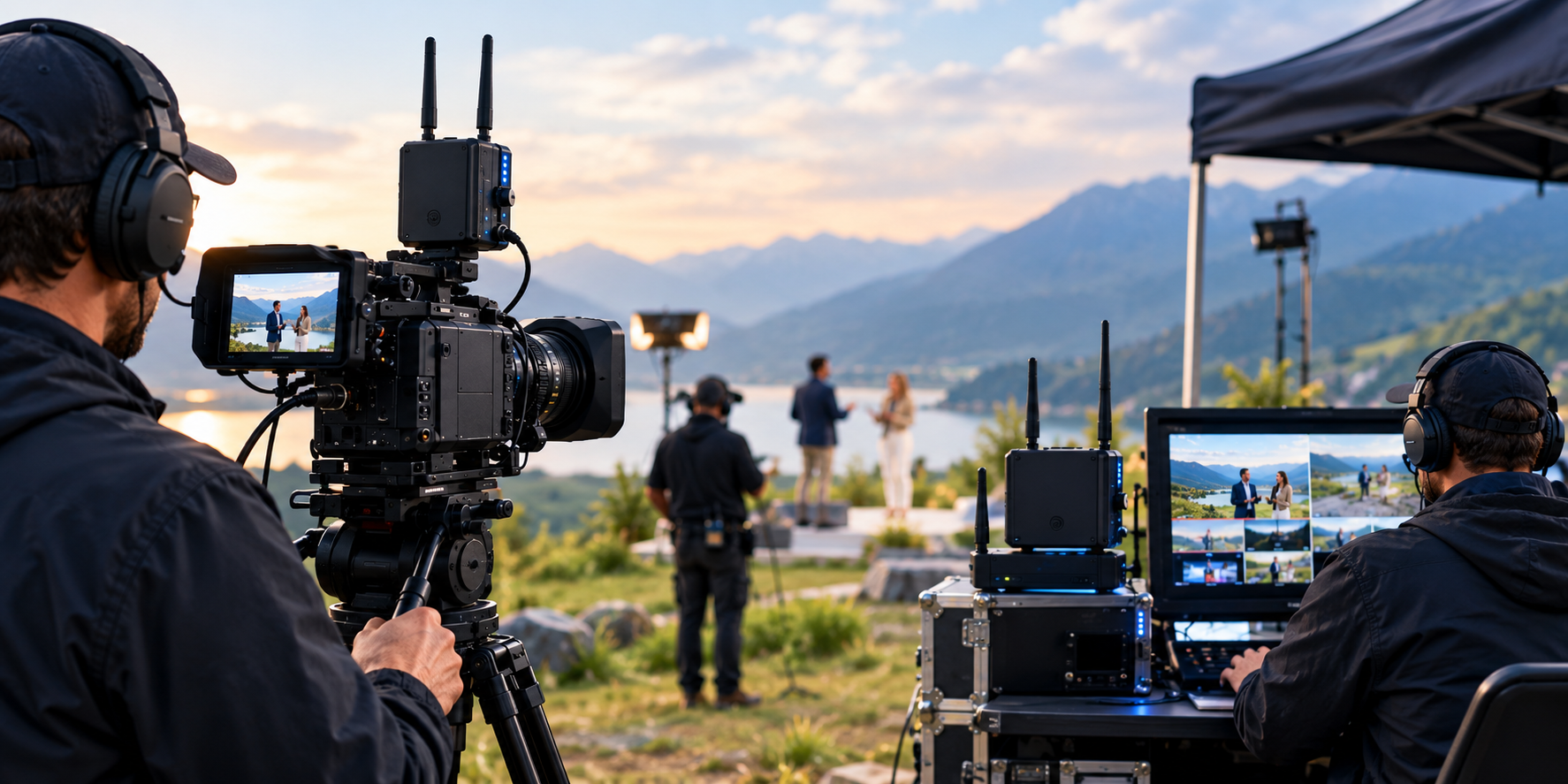
Corporate events, award ceremonies, and live-streamed conferences benefit from wireless monitoring. Directors, lighting designers, and floor managers can all view the programme feed on wireless monitors placed wherever they need them, without cable runs across venue floors.
Multi-Camera Film and Drama
Wireless monitoring allows the DOP and director to view multiple camera angles simultaneously from a central position. The VITA PRO supports multi-receiver setups, so several monitors can receive the same transmitter feed independently.
What Should You Know Before Hiring Wireless Broadcast Equipment?
Every piece of WaveHire equipment is fully tested and paired before dispatch. Whether you collect from our London facility or we ship to you 1–2 days before your production anywhere in the UK, the system arrives ready to power on and use. Contact the team to confirm exactly what is included with your hire and discuss any accessories you need for your specific setup.